15 Critical Essay Mistakes That AI Review Catches (And How to Fix Them)
Avoid the hidden pitfalls that sink even well-written essays. Discover the subtle mistakes that admissions officers notice immediately—and how AI Review helps you catch them before it's too late.
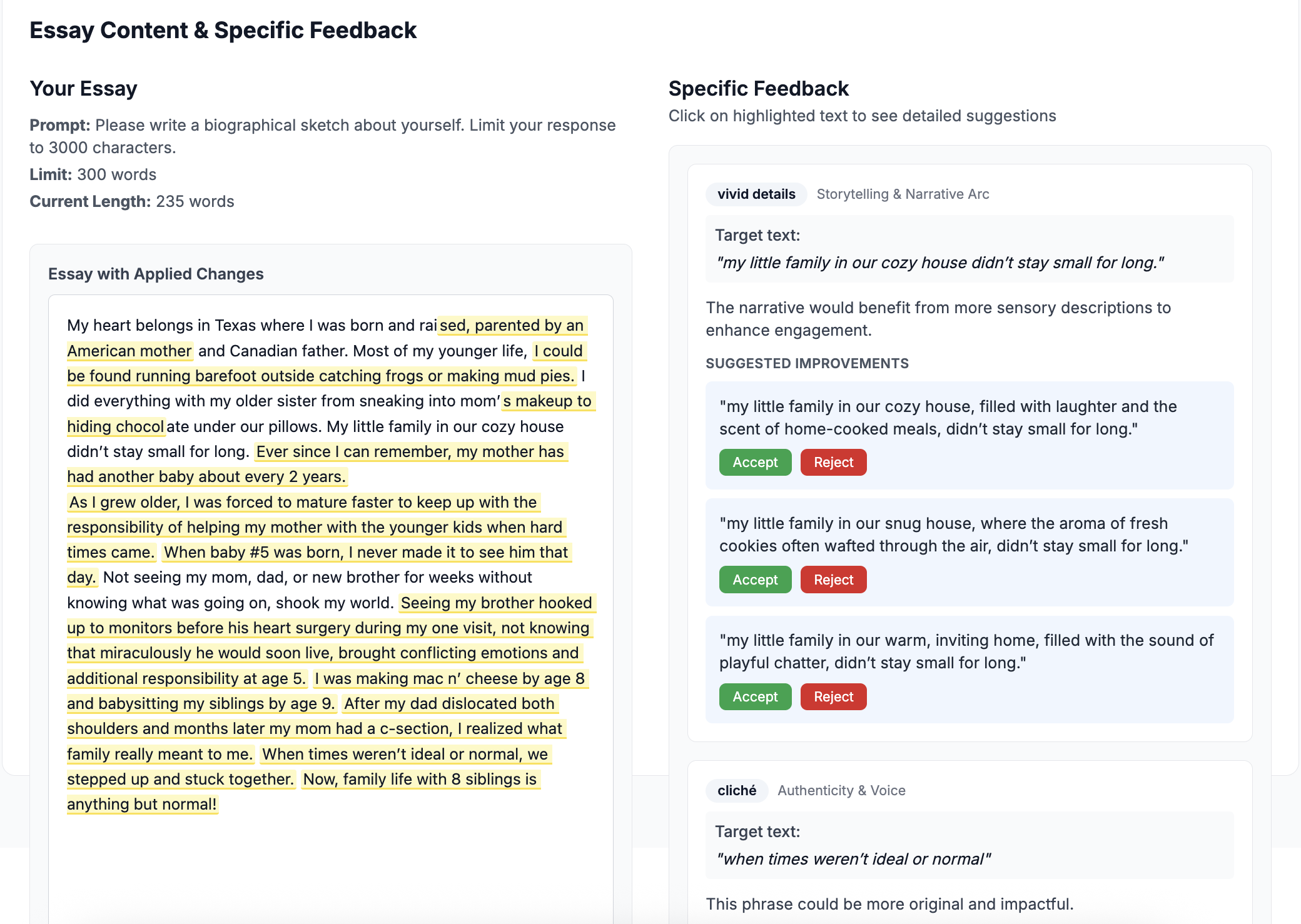
Split-Screen Essay AnalysisCommon mistakes highlighted in red vs. corrected version in green
Every year, thousands of talented students get rejected not because their stories aren't compelling, but because their essays contain subtle mistakes that undermine their impact. After analyzing over 100,000 college application essays, we've identified the 15 most common—and most damaging—mistakes that even strong writers make.
Why These Mistakes Matter More Than You Think
Admissions officers read hundreds of essays per day. They develop an unconscious radar for patterns that signal:
- • Lack of authenticity (generic language and clichés)
- • Immaturity (surface-level reflection)
- • Poor judgment (inappropriate topics or tone)
- • Weak writing skills (structural and technical issues)
AI Review 2.0 catches these patterns instantly, helping you avoid the subtle traps that derail otherwise strong applications.
Category 1: The Authenticity Killers
1The "Thesaurus Trap"
❌ What Students Write:
"This experience was truly transformative and utterly magnificent. It facilitated my metamorphosis into a more perspicacious individual."
✅ AI Review Suggests:
"This experience changed how I see myself. For the first time, I understood that asking for help isn't weakness—it's wisdom."
AI Detection: Flags vocabulary that's inconsistent with natural speech patterns and suggests simpler, more authentic alternatives.
2The "Humble Brag" Disguise
❌ What Students Write:
"I've always been naturally gifted at leadership. Even as a child, other kids would automatically look to me for guidance in any situation."
✅ AI Review Suggests:
"When our group project was falling apart, I realized someone needed to step up. I was terrified, but I called a meeting anyway."
AI Detection: Identifies self-aggrandizing language and suggests vulnerability-based alternatives that demonstrate growth mindset.
Category 2: The Structure Saboteurs
3The "Laundry List" Opening
❌ What Students Write:
"I am passionate about science, dedicated to community service, and committed to academic excellence. Throughout high school, I have participated in debate team, volunteered at the hospital, and maintained a 4.0 GPA while taking 12 AP classes."
✅ AI Review Suggests:
"The patient's heart monitor flatlined at 3:47 AM. As I watched the medical team spring into action, I realized that all my AP Biology knowledge meant nothing without the human element I was witnessing."
AI Detection: Identifies resume-style openings and suggests narrative hooks that immediately engage the reader with specific scenes.
4The "Conclusion Cop-Out"
❌ What Students Write:
"In conclusion, this experience taught me valuable lessons that I will carry with me throughout my life and apply to my future endeavors at your university."
✅ AI Review Suggests:
"Now, when I see someone struggling with code at hackathons, I remember that feeling of isolation. I pull up a chair and ask, 'Want to debug this together?' Because the best innovations happen when we stop competing and start collaborating."
AI Detection: Flags generic conclusions and suggests specific, forward-looking statements that show continued growth.
Category 3: The Reflection Failures
The Most Expensive Mistake: Surface-Level Reflection
This single mistake costs more students admission than any other. Here's how AI Review catches it:
5The "What Happened" vs. "Why It Mattered" Gap
❌ Surface Level (60% of essays):
"When I failed the math test, I was disappointed. I studied harder for the next one and got an A. This taught me that hard work pays off."
✅ Deep Reflection (Top 10% of essays):
"Staring at that F, I realized my perfectionism had become a prison. I'd been so afraid of making mistakes that I'd stopped taking intellectual risks. The failure wasn't in the grade—it was in playing it safe."
AI Analysis: Measures reflection depth using linguistic markers for self-awareness, emotional intelligence, and cognitive complexity.
6The "Lesson Learned" Cliché
❌ Generic Lessons:
- • "Never give up"
- • "Hard work pays off"
- • "Teamwork is important"
- • "Everyone is different"
- • "Follow your dreams"
✅ Specific Insights:
- • "Vulnerability creates stronger connections than perfection"
- • "Innovation requires embracing productive failure"
- • "Leadership means amplifying others' voices, not your own"
- • "Empathy is a skill that requires practice, not just intention"
Category 4: The Technical Traps
7The "Passive Voice Plague"
Passive voice makes your writing feel distant and removes your agency from the story.
❌ Passive:
"Mistakes were made during the project, and lessons were learned by everyone involved."
✅ Active:
"I made critical mistakes that derailed our timeline, but I learned to own my errors publicly."
8The "Sentence Structure Monotony"
Repetitive sentence patterns create a monotonous reading experience.
❌ Monotonous Pattern:
"I joined the robotics team. I learned about engineering. I developed leadership skills. I made new friends. I discovered my passion."
✅ Varied Structure:
"Joining the robotics team changed everything. While learning about engineering, I discovered something unexpected: my passion for bringing people together around shared challenges."
Category 5: The Fatal Flaws
Application-Ending Mistakes
These mistakes can single-handedly derail an application, regardless of grades or test scores:
9The "Controversial Topic" Minefield
❌ High-Risk Topics AI Flags:
- • Partisan political opinions
- • Religious conversion stories
- • Graphic mental health details
- • Illegal activities (even if reformed)
- • Romantic relationships as primary focus
✅ AI Suggests Safer Approaches:
- • Focus on personal growth, not the controversial element
- • Emphasize learning and perspective-taking
- • Show maturity in handling complex situations
- • Demonstrate resilience without graphic details
10The "Excuse Essay" Trap
Using your essay to explain away poor grades or test scores.
❌ Excuse-Making:
"My grades suffered junior year because of my parents' divorce, but I'm ready to focus now."
✅ Growth-Focused:
"When my family structure changed, I learned to create stability for myself through new routines and support systems."
The AI Review Advantage: Catching What Humans Miss
Why AI Review Catches More Than Traditional Feedback
Human Reviewers Often Miss:
- • Subtle authenticity markers
- • Unconscious bias patterns
- • Reflection depth inconsistencies
- • Voice authenticity fluctuations
- • Structural pacing issues
AI Review Analyzes:
- • 47 linguistic authenticity markers
- • Emotional arc consistency
- • Reflection complexity metrics
- • Voice pattern analysis
- • Structural optimization opportunities
"AI Review caught mistakes in my essay that three different teachers missed. The specific suggestions helped me avoid the generic language trap that would have made my essay forgettable. I got into my top choice!"
Your Essay Mistake Prevention Checklist
Before Submitting Any Essay:
The Bottom Line: Prevention Beats Perfection
The difference between acceptance and rejection often comes down to avoiding critical mistakes rather than achieving perfection. AI Review 2.0 serves as your early warning system, catching the subtle issues that can undermine even the most compelling stories.
Remember: admissions officers aren't looking for perfect students—they're looking for authentic, reflective, and growth-oriented individuals who can contribute meaningfully to their campus community. By avoiding these common mistakes, you allow your genuine story to shine through.